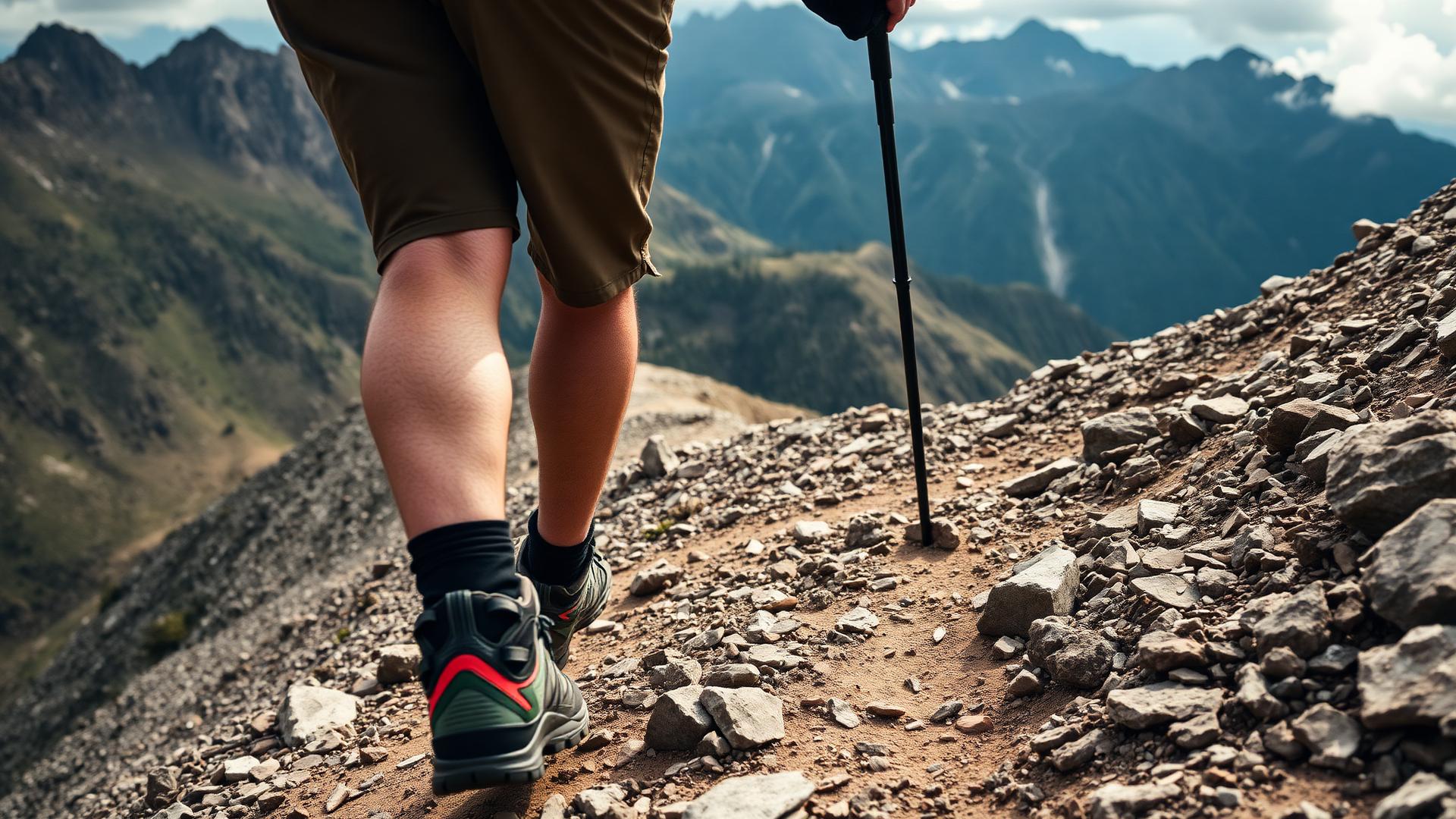
How to Reduce Knee Strain on Steep Walks
Techniques, exercises, and gear that protect your knees on steep descents — from stride adjustments to braces to powered assistive devices.
Disclosure: Some links on this page are affiliate links. We may earn a commission if you make a purchase — at no extra cost to you. Learn more.
Key Takeaways
- Impact forces during downhill hiking can reach 7–8x your body weight.
- Shorter downhill strides reduce knee impact force significantly.
- A slight knee bend engages muscles as shock absorbers, protecting cartilage.
- Trekking poles reduce downhill knee impact by up to 25%.
- Powered devices actively assist during the descent phase, reducing quad loading.
Steep descents are where knees take the biggest beating. Impact forces during downhill hiking can reach 7–8 times your body weight — and without proper technique or support, that stress accumulates quickly, leading to pain, inflammation, and long-term damage.
Why Knees Hurt on Descents
Downhill walking requires eccentric contractions — your quadriceps lengthen under load to control your descent. This braking action creates enormous compressive forces on your patella (kneecap) and the cartilage beneath it.
Unlike concentric muscle work (pushing uphill), eccentric contractions cause more micro-damage to muscle fibers. This is why your knees and quads are often more sore after a hike with lots of downhill than one with the same elevation going up.
Shorten Your Downhill Stride
Long steps downhill increase impact force dramatically. Each large step-down acts like a small jump landing. Shorter, controlled steps distribute the load more evenly and give your quads more time to control deceleration.
Keep Knees Slightly Bent
Landing with locked knees sends impact directly through the joint with zero muscular cushioning. A slight bend — about 15–20 degrees — engages your muscles as shock absorbers, protecting the cartilage and ligaments underneath.
Strengthen Your Quads
Your quadriceps are the primary braking muscles on descents. Weak quads transfer more force to your knee joint. Key exercises:
- Wall sits: 3 sets of 30–60 seconds, 3x per week
- Step-downs: Slow, controlled step-downs from a 20cm platform, 3 sets of 10 per leg
- Eccentric squats: 5-second lowering phase, normal rise, 3 sets of 8
Timeline
Consistent quad strengthening for 4–6 weeks typically produces noticeable improvement in downhill knee comfort. Most hikers report being able to descend steeper terrain with significantly less pain.
Trekking Poles for Descent
Using poles on downhill sections reduces knee impact by up to 25%. Plant them ahead of you and let your arms share the braking effort. Adjust poles slightly longer than your uphill setting for descents.
Braces, Sleeves, and Beyond
Compression sleeves provide warmth, light support, and proprioceptive feedback — making you more aware of knee position. They work well for prevention and mild discomfort.
Hinged braces offer more structural support for moderate to severe knee instability. They limit dangerous lateral movement while allowing flexion and extension.
Powered Knee Assistance
The newest category of knee protection doesn't just support the joint — it actively assists. Powered exoskeletons reduce the muscular force your quads need to generate during descent, addressing the root cause of most hiking knee pain.
HyperShell vs Knee Brace: Which Gives Better Protection?
We compare high-tech powered assistance with traditional knee braces for hiking. See which approach suits your needs.
Read the ComparisonFrequently Asked Questions
Dr. Sarah Lin
Sarah is a sports physiotherapist and avid hiker who specializes in lower-limb biomechanics. She consults on injury prevention for hiking and trail running athletes.